
What Is a Vacation Rental Agreement? A Renter's Guide


A vacation rental agreement is a legally binding contract that defines the terms and responsibilities between a property owner and a guest for a short-term rental stay, typically lasting 30 days or less. You will encounter this document whether you book through a platform like Airbnb or VRBO, or directly with a private owner. The contract protects both sides by spelling out payment terms, house rules, cancellation policies, and liability. Knowing what to look for before you sign makes the difference between a relaxed vacation and an expensive misunderstanding.
What is a vacation rental agreement and what does it cover?
A vacation rental agreement, also called a short-term rental agreement or vacation rental contract, is a one-time legal document that governs a single stay. It is not the same as a residential lease. The contract expires on the check-out date with no automatic renewal, which means your rights and obligations end the moment you leave the property.
The core elements you should expect in any well-drafted vacation rental contract include the following:
Rental dates and duration. The exact check-in and check-out dates, plus the times for each.
Total rental rate and payment schedule. The nightly or weekly rate, when payment is due, and accepted payment methods.
Security deposit terms. The deposit amount, what it covers, and the timeline for its return.
Occupancy limits. The maximum number of guests permitted, including children.
Pet policy. Whether pets are allowed, any breed or size restrictions, and associated fees.
House rules. Noise curfews, smoking policies, pool usage hours, and parking instructions.
Cancellation policy. The deadline for cancellations and the refund or forfeiture terms that apply.
Damage and maintenance clauses. Who is responsible for accidental damage and how it is reported.
Occupancy limits, damage liability, and cleaning fees are among the most common clauses that prevent disputes. Each one sets a clear expectation so neither party is surprised mid-stay.
Pro Tip: Read the cancellation policy before you read anything else. Canceling within a close window, sometimes as short as 10 days before arrival, often results in forfeiture of your security deposit. That is the clause most renters overlook until it is too late.

How does a vacation rental agreement differ from a standard lease?
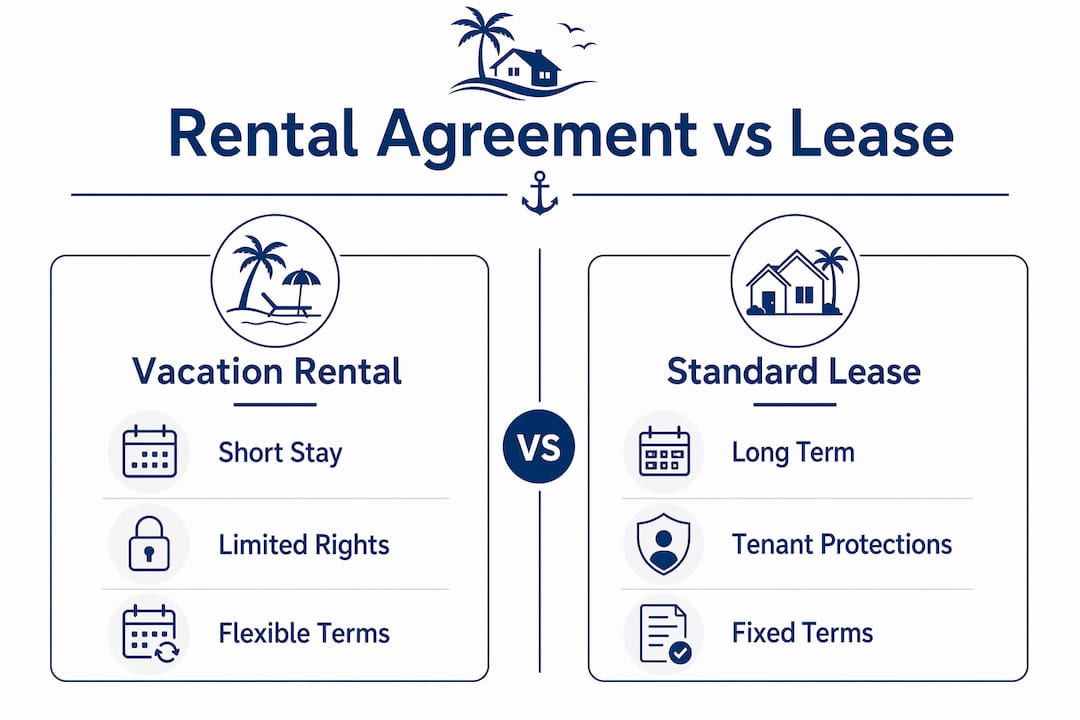
The difference between a vacation rental contract and a traditional residential lease goes well beyond length of stay. A standard lease is a periodic agreement, often month-to-month or year-to-year, designed for someone making a property their primary residence. A vacation rental agreement is a one-time arrangement built around a specific trip.
Feature | Vacation Rental Agreement | Standard Residential Lease |
Typical duration | 1–30 days | 6–12 months or longer |
Renewal | No automatic renewal; expires at check-out | Often renews automatically |
Primary purpose | Tourism and leisure | Residential living |
Cancellation terms | Strict, often non-refundable | Governed by state tenant law |
Legal protections | Short-term rental statutes | Full tenant rights under state law |
Deposit handling | Returned within days of departure | Held for lease duration |
The legal protections available to you also differ significantly. Residential tenants in most U.S. states have strong statutory rights covering habitability, eviction procedures, and deposit timelines. Short-term rental guests operate under a narrower set of protections, which is exactly why a clear, written vacation rental contract matters so much. The document itself becomes your primary form of recourse if something goes wrong.
Understanding this distinction also helps when comparing vacation rentals versus hotel stays. Hotels operate under hospitality law, not rental contract law. The moment you sign a vacation rental agreement, you are entering a different legal relationship entirely.
Why is a vacation rental agreement important for direct bookings?
When you book through a major platform, that platform provides a layer of policy protection. When you book directly with a property owner, that layer disappears. OTA platforms like Airbnb have internal policies, but those policies do not replace a direct legal agreement between host and guest. A written vacation rental contract fills that gap.
“A well-drafted agreement is the foundation for professional trust and reduces misunderstandings in property use and fees.” — Lodgify
Without a written agreement, disputes over damages, missing amenities, or early departures have no clear resolution path. The contract acts as legal evidence if a conflict escalates. It also clarifies house rules that a listing description might not fully address, such as whether a generator is available during a storm or whether the outdoor grill is included in the rental.
No federal or state law requires a written agreement for all short-term stays, but every experienced property manager recommends one. The document protects the guest just as much as it protects the owner. You gain written confirmation of what was promised, and the owner gains documented acknowledgment of the rules you agreed to follow.
Pro Tip: For direct bookings, ask the owner to send the vacation rental contract at least 48 hours before your payment deadline. That gives you time to read it carefully and request any changes without pressure. Reviewing vacation rental platform options before committing to a direct booking can also help you understand what protections you may be giving up.
How to read your rental agreement before booking
Reading a vacation rental contract does not require a law degree. It requires patience and a clear checklist. Work through the document in this order to catch the details that matter most.
Check the dates first. Confirm the check-in and check-out dates match your booking exactly. A typo here can cost you a full night’s rate.
Review the payment schedule. Note when the balance is due and whether the deposit is separate from the total rental rate.
Read the cancellation policy in full. Identify the exact deadline and what percentage of your payment you forfeit if you cancel after that date.
Count the occupancy limit. If you are traveling with a large group, confirm the maximum guest count covers everyone, including day visitors.
Look for hidden fees. Cleaning fees, parking fees, and pet fees are sometimes listed separately from the advertised nightly rate.
Identify the damage clause. Understand whether a security deposit covers accidental damage or whether you are liable beyond the deposit amount.
Flag ambiguous language. If a clause says “reasonable use” without defining it, ask the owner for clarification in writing before you sign.
Common red flags include vague damage liability language, cancellation policies with no refund under any circumstances, and occupancy rules that do not account for children. If you spot a clause that feels unfair or unclear, request an amendment. Most private owners are willing to clarify terms in writing, especially for a confirmed booking. Understanding how a management company handles agreements can also give you a benchmark for what a professional contract should look like.
What do common vacation rental clauses actually mean?
Real contract language can feel dense. Here is what the most common clauses mean in plain terms.
“Guest assumes all liability for damages beyond normal wear and tear.” You are responsible for anything broken or damaged during your stay that goes beyond routine use. A scuffed wall is normal wear. A broken door is not.
“Occupancy is limited to [X] persons. Violation results in immediate termination of the rental agreement.” Bringing extra guests without permission is grounds for eviction with no refund.
“Cancellations made within [X] days of arrival forfeit the security deposit.” If you cancel too close to your arrival date, you lose the deposit regardless of the reason.
“The property will be professionally cleaned upon departure. Guest is responsible for leaving the property in a tidy condition.” You do not need to deep-clean, but you should remove trash, wash dishes, and leave the space orderly.
Clause Type | Plain Meaning | Why It Matters |
Damage liability | Guest pays for damage beyond normal use | Protects owner from repair costs |
Occupancy limit | Hard cap on guest count | Prevents overcrowding and wear |
Cancellation window | Refund eligibility based on timing | Defines your financial risk |
Cleaning fee | One-time fee added to total cost | Affects true cost of the stay |
House rules violation | Can result in early termination | Sets behavioral expectations |
These clauses are not designed to intimidate you. They exist because agreements serve as the backbone for transactions that lack third-party platform protection. A clear clause benefits both sides by removing guesswork entirely.
Key takeaways
A vacation rental agreement is a one-time legal contract that protects both guests and property owners by defining payment terms, house rules, cancellation policies, and damage liability for short-term stays.
Point | Details |
Definition and scope | A vacation rental agreement covers stays of 1–30 days and expires automatically at check-out. |
Essential components | Every contract should include rental dates, payment terms, occupancy limits, and cancellation policy. |
Direct booking risk | Without a platform, a written vacation rental contract is your only legal protection. |
Key reading strategy | Review cancellation and damage clauses first; flag vague language before signing. |
Lease vs. rental contract | Vacation agreements lack automatic renewal and offer fewer tenant protections than residential leases. |
What i have learned after years of watching renters sign without reading
Most renters treat the vacation rental contract as a formality. They scroll to the signature line, check the box, and move on to planning their itinerary. That habit is the single most common source of avoidable conflict I have seen in this industry.
The guests who have the smoothest stays are the ones who ask questions before they arrive. Not because they are suspicious, but because they understand that a well-run property comes with clear terms. When a management company or private owner provides a thorough agreement, that is actually a good sign. It means they have thought through the details and they respect your time enough to put everything in writing.
The clause that surprises people most is almost always the cancellation policy. I have seen guests lose a full week’s deposit because a family emergency fell inside the no-refund window. Travel insurance exists precisely for this reason, and the vacation rental contract is the document that makes that insurance claim possible.
My honest advice: treat the agreement like a conversation, not a hurdle. If something reads as unclear, ask. If a clause feels one-sided, say so. Most owners who manage quality properties want you to feel comfortable before you arrive. A good agreement does not create friction. It removes it.
— Josh
Book a captiva island rental with transparent terms
Captiva-island takes the guesswork out of vacation rental contracts. Every property managed through American Realty of Captiva comes with clear, professionally drafted rental terms so you know exactly what you are agreeing to before you pay a dollar.

Whether you are drawn to a beachfront home on Captiva or a private pool retreat, the team at Captiva-island provides full documentation before your booking is confirmed. Browse the complete collection of available Captiva rentals and reach out with any questions about terms, deposits, or house rules. With over 30 years of local expertise, American Realty of Captiva makes sure your agreement is as comfortable as the property itself.
FAQ
What is a vacation rental agreement in simple terms?
A vacation rental agreement is a written contract between a property owner and a guest that outlines the rules, payment terms, and responsibilities for a short-term stay, typically 30 days or less.
Is a vacation rental contract legally binding?
Yes. A signed vacation rental agreement is a legally binding document. It can be used as evidence in disputes over damages, cancellations, or violations of house rules.
What is the difference between a lease and a rental agreement?
A residential lease is a long-term, periodically renewing contract with full tenant protections. A vacation rental agreement expires on the check-out date with no renewal and fewer statutory protections for the guest.
Do i need a vacation rental agreement if i book through airbnb?
Airbnb provides platform-level policies, but those do not replace a direct legal agreement. For direct bookings outside major platforms, a written vacation rental contract is the only formal protection available to both parties.
What should i do if i disagree with a clause in the rental agreement?
Contact the owner or property manager in writing before signing. Request a clarification or amendment. Most professional hosts are willing to address reasonable concerns, and having the response in writing protects you if a dispute arises later.
Recommended
Comments